
The Best Children’s Educational Books: Inspiring Lifelong Curiosity and Wonder
The finest educational books rarely feel like schoolwork. Instead of lecturing, they open hidden trapdoors in a child’s imagination, transforming everyday questions—like why the sky changes color or how ants build underground cities—into grand adventures. In an era dominated by flashing screens and bite-sized algorithms, holding a well-crafted book offers something digital media cannot: sustained focus, tactile engagement, and the space to wonder.
- What Makes an Educational Book Truly Great?
- Quick Comparison: Standout Titles by Age and Subject
- 1. STEM & Scientific Inquiry: Building Problem Solvers
- 2. Astronomy & Earth Sciences: Expanding Perspective
- 3. History, Biographies, & Global Empathy
- 4. Emotional Intelligence and Problem-Solving
- How to Turn Reading into an Active Learning Experience
- Frequently Asked Questions
Finding the best children’s educational books means looking past dry memorization and focusing on stories that spark active inquiry. Whether your young reader is a toddler pointing at pictures, an elementary student obsessed with space, or a middle-grader tackling real-world problems, the right book turns learning into an organic habit rather than an assigned chore.
We Are Teachers
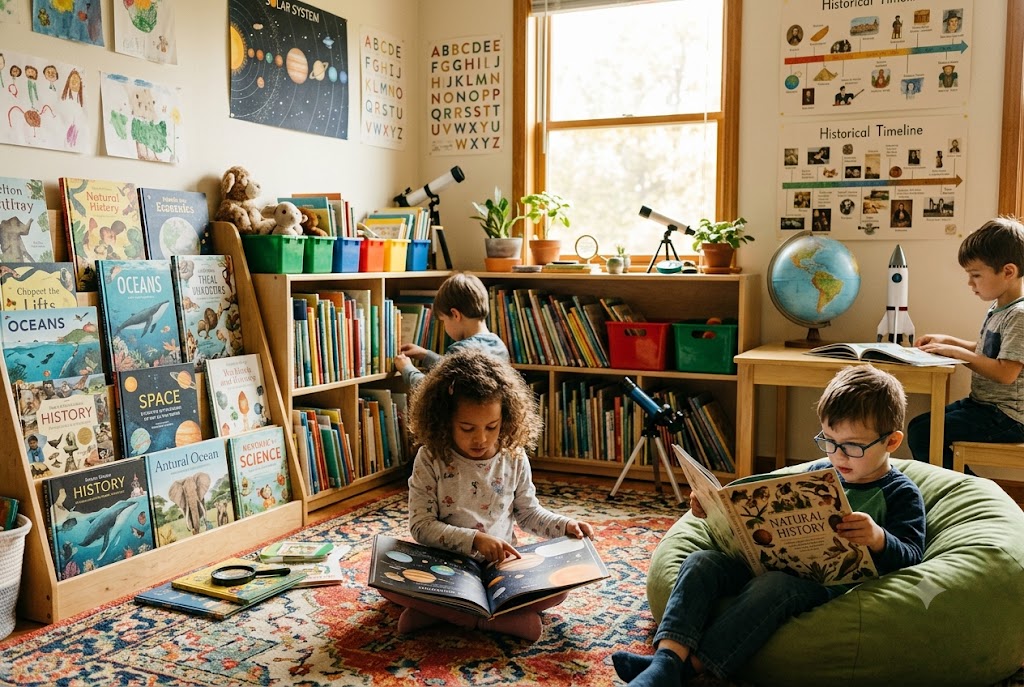
Cultivating early curiosity through story-driven learning. Source: Magnific
What Makes an Educational Book Truly Great?
Before building a home or classroom library, it helps to understand what separates an exceptional book from a forgettable one. Research in developmental psychology and reading pedagogy highlights three core traits that define top-tier educational literature:
- Narrative-Driven Exploration: Children remember narratives far better than lists of isolated facts. When complex principles—such as gravity, biodiversity, or historical movements—are woven into compelling storylines with relatable characters, kids retain the concepts effortlessly.
- Visual Literacy and Cognitive Pacing: A dense wall of text can overwhelm a developing reader. Dynamic layouts, labeled diagrams, cutaways, and expressive illustrations invite children to pause, inspect details, and construct mental models at their own pace.
- Inquiry Over Didactic Answers: The most impactful books celebrate questions. They show protagonists asking “Why?”, running experiments, making mistakes, and rethinking their assumptions. This builds scientific literacy and resilience simultaneously.
Quick Comparison: Standout Titles by Age and Subject
The table below breaks down premier educational selections across developmental stages and academic disciplines:
| Book Title | Primary Subject | Target Age | Key Developmental Benefit |
|---|---|---|---|
| Ada Twist, Scientist | STEM & Scientific Method | Ages 4–8 | Normalizes trial, error, and persistent inquiry |
| The Magic School Bus Series | Earth, Life, & Physical Science | Ages 6–10 | Translates microscopic and vast concepts into visual narrative |
| National Geographic Little Kids First Big Book of Space | Astronomy & Earth Sciences | Ages 3–8 | Builds visual literacy with authentic high-resolution planetary photos |
| What Do You Do with a Problem? | Social-Emotional Learning (SEL) | Ages 5–9 | Reframes adversity and challenges as growth opportunities |
| The Boy Who Harnessed the Wind (Young Readers Ed.) | Engineering, History, & Culture | Ages 8–12 | Highlights practical problem-solving, grit, and global empathy |
| Here We Are: Notes for Living on Planet Earth | Environmental Literacy & Ethics | Ages 3–7 | Nurtures global citizenship and environmental stewardship |
1. STEM & Scientific Inquiry: Building Problem Solvers
Science, technology, engineering, and math (STEM) can feel abstract when introduced through worksheets. These standout titles bring the scientific process alive through relatable protagonists and vibrant visual adventures.
Ada Twist, Scientist by Andrea Beaty, illustrated by David Roberts
Ada Twist, Scientist by Andrea Beaty. Source: Paper Plus
Few modern picture books capture the chaotic joy of childhood curiosity quite like Ada Twist, Scientist. Inspired by trailblazing female scientists Ada Lovelace and Marie Curie, the story follows young Ada, whose boundless drive to understand why, how, and when leads to delightfully messy experiments.
Kid Spark Education
What makes this book an essential entry among the best children’s educational books is how it handles failure. When an experiment doesn’t yield the expected answer, Ada doesn’t quit; she treats the outcome as data and formulates a new hypothesis. David Roberts’ whimsical graph-paper illustrations reinforce the connection between creativity and rigorous thinking.
- Key Takeaway: Science is not about having all the answers—it is about having the courage to ask bold questions.
- Discussion Prompt for Parents: “When Ada’s experiment smelled awful, what was the very next thing she did instead of giving up?”
The Magic School Bus: Inside the Earth by Joanna Cole, illustrated by Bruce Degen
The Magic School Bus: Inside the Earth. Source: Audible
Decades after its debut, Joanna Cole’s classic series remains an unmatched gold standard for elementary science literature. In Inside the Earth, Ms. Frizzle leads her eccentric class on a field trip directly through the crust, mantle, and core of our planet.
The book excels through multi-layered storytelling. Main narrative blocks carry the plot forward, dialogue bubbles inject lighthearted humor, and mock student reports lined along the margins unpack geological facts about sedimentary, metamorphic, and igneous rock formations. Readers can revisit this book half a dozen times and discover new diagrams, cross-sections, and footnotes on every read.
- Key Takeaway: Geological processes shape the ground beneath our feet every second.
- Hands-on Extension: Collect three different rocks from your backyard or neighborhood park and classify them based on texture, color, and layer visibility.
2. Astronomy & Earth Sciences: Expanding Perspective
Children possess a natural awe for the cosmos. Introducing astronomical scales and environmental awareness early gives young learners a healthy perspective on their place in the universe.
National Geographic Little Kids First Big Book of Space by Catherine D. Hughes
High-contrast planetary spreads in National Geographic’s Space guide. Source: Palomar Observatory Gift and Book Store – Caltech
National Geographic has mastered the art of visual nonfiction. In this large-format volume, Catherine D. Hughes introduces early learners to our solar system, nebulae, comets, and constellations.
Rather than relying purely on simplified cartoons, the book pairs accessible text with genuine satellite imagery and high-definition spacecraft photography. The spreads feature bite-sized “Fast Fact” callouts (such as how Mercury orbits the sun in just 88 Earth days) alongside tactile comparisons that ground cosmic scale in concepts kids understand.
Kid Spark Education
- Key Takeaway: The universe is vast, structured, and observable through tools built by human curiosity.
- Reading Tip: Use the book’s interactive questions at the bottom of each spread to practice observational comparison with your reader.
Here We Are: Notes for Living on Planet Earth by Oliver Jeffers
Written as a gentle guide for the author’s newborn child, Oliver Jeffers’ Here We Are is equal parts planetary primer and humanitarian manifesto. The book wanders through the solar system, down through Earth’s atmosphere, into the bustling diversity of city life, and out across wild oceans and deserts.
Jeffers captures complex environmental realities—such as finite natural resources, human physical variety, and climate responsibility—with warmth and understated wit. It serves as a gentle foundational text for teaching ecology, empathy, and global stewardship to preschoolers and early elementary students alike.
3. History, Biographies, & Global Empathy
History for young children often suffers when reduced to dates and treaty names. To make history resonate, children’s educational books must foreground the human spirit, showing how ordinary people shaped our modern world through grit and conviction.
Ordinary People Change the World Series by Brad Meltzer, illustrated by Christopher Eliopoulos
From I Am Rosa Parks and I Am Albert Einstein to I Am Jane Goodall, Brad Meltzer’s biography series transforms legendary figures into approachable, pint-sized role models. Each book portrays the subject as a child facing doubt, unfair rules, or initial setbacks, complete with friendly comic-strip pacing and speech bubbles.
Instead of presenting historical heroes as flawless statues, Meltzer emphasizes their internal values: kindness, courage, persistence, and justice. A full historical timeline and genuine archive photos conclude each volume, providing educational scaffolding for older siblings and classrooms.
The Boy Who Harnessed the Wind (Young Reader’s Edition) by William Kamkwamba and Bryan Mealer
Set in rural Malawi during an intense drought, this autobiographical narrative recounts how fourteen-year-old William Kamkwamba used discarded bicycle parts, scrap metal, and library physics books to build a working windmill. His creation brought electricity and water pumping to his village, fundamentally changing his community’s future.
For upper-elementary and middle-school readers, Kamkwamba’s story is a masterclass in practical engineering, sustainability, and resourcefulness. It proves that innovation requires curiosity and persistence far more than expensive laboratory equipment.
4. Emotional Intelligence and Problem-Solving
Cognitive development cannot be detached from emotional literacy. An educational book that teaches a child how to navigate frustration, self-doubt, and ambiguity provides cognitive tools that support every other academic discipline.
What Do You Do with a Problem? by Kobi Yamada, illustrated by Mae Besom
When an unwelcome problem appears, a young child tries to ignore it, hide from it, and run away—only to watch it swell into a looming storm cloud. When the child finally confronts the problem with courage, they discover a hidden core: opportunity.
Kid Spark Education
Yamada’s poignant text and Besom’s expressive pencil-and-watercolor illustrations capture the psychological burden of anxiety and procrastination in a way young minds instantly grasp. It is one of the most effective non-didactic tools for teaching growth mindset, emotional resilience, and metacognition.
How to Turn Reading into an Active Learning Experience
Selecting the best children’s educational books is only half the equation; the way adults read with children dictates how deeply the material sinks in. Educators call this dialogic reading—turning a passive monologue into an interactive conversation.
- Ask Open-Ended Inquiries: Instead of asking, “What color is that truck?”, ask, “Why do you think the engineer chose tracks instead of wheels for that machine?” This prompts analytical deduction rather than simple memory retrieval.
- Connect Pages to the Physical World: If a book touches on plant transpiration, set a celery stalk in water with food coloring that afternoon. When literature connects directly to physical reality, concepts solidify into long-term memory.
- Follow the Child’s Curiosity Trails: If a single illustration of a deep-sea creature in an ocean atlas captures your child’s imagination, spend the next library trip checking out titles specifically about bioluminescence or the Mariana Trench. Self-directed reading builds intrinsic motivation.
- Normalize Not Knowing: When your reader asks a challenging question about how gravity bends light or why dinosaurs went extinct, model intellectual honesty: “That’s an incredible question. I don’t know the full answer—let’s look it up together.”
Frequently Asked Questions
Should I choose narrative fiction or direct nonfiction for science learning?
Both are vital. Narrative fiction (like Ada Twist, Scientist) builds emotional resonance, humanizes the scientific method, and reduces subject intimidation. Direct nonfiction (like National Geographic volumes) builds disciplinary vocabulary, visual literacy with diagrams, and factual understanding. Blending both gives children a well-rounded foundation.
At what age should I introduce nonfiction books to children?
You can introduce nonfiction as early as infancy through sensory board books featuring real animal photos, textures, and simple vocabulary. By ages 3 to 5, children actively seek to understand how the real world works and frequently show a strong preference for books about real vehicles, animals, weather, and space over purely fictional stories.
How can educational books help reluctant readers?
Reluctant readers often struggle with continuous blocks of text. Highly visual educational books—such as graphic novels, illustrated cross-sections, and encyclopedias with bite-sized callout boxes—relieve cognitive strain. They allow children to gather knowledge non-linearly, building confidence without feeling pressured to read cover-to-cover in one sitting.