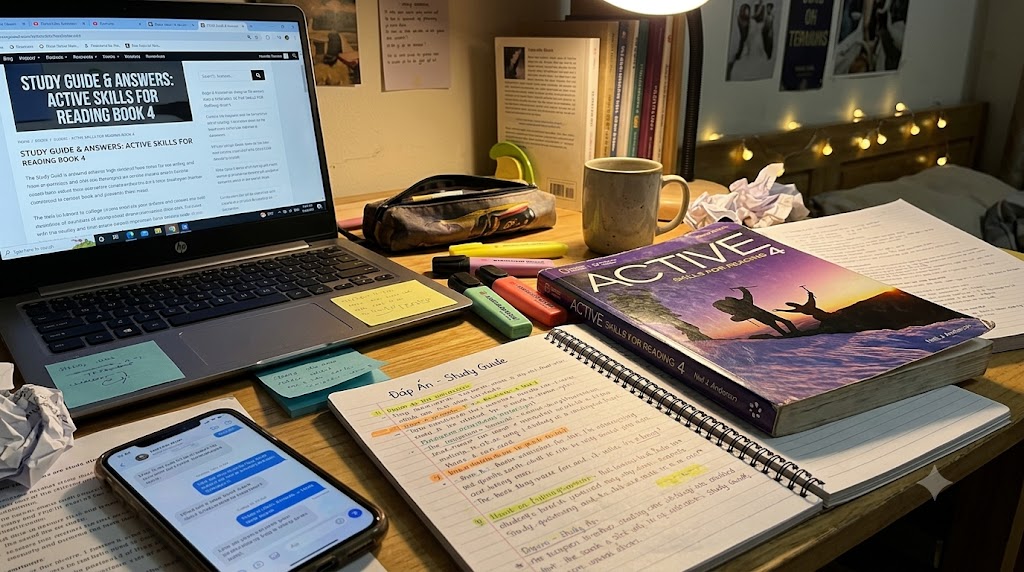

Dap an Active Skills for Reading Book 4: The Ultimate Guide to Understanding Answers and Acing Your Course
It is 11:30 PM on a Sunday night. You have an open copy of Active Skills for Reading Book 4 by Neil J. Anderson sitting in front of you, a pencil in hand, and an assignment due the next morning. You are staring at a dense passage about job interview dynamics, solar storms, or cyber security, trying to figure out why your answer for question 4 doesn’t match what your teacher expects.
Naturally, you type “dap an active skills for reading book 4” into your search bar, hoping to find a quick answer key to check your work.
Tackling advanced reading units with collaborative study. Source: photosaint / Getty Images
Searching for solutions is completely normal when you feel stuck on advanced English texts. Book 4 is the upper-intermediate to advanced tier of the Active Skills series, widely used across high schools, universities, and test-prep academies. The texts are longer, the vocabulary is more academic, and the questions require serious critical thinking rather than simple word-matching.
Simply copying letter options (A, B, C, or D) from a blurry scanned PDF will not help you pass your midterm, IELTS, or VSTEP exam. The real secret is understanding how the questions are designed and how to find the correct answers every single time.
This comprehensive guide breaks down the core units, decodes the trickiest question types, and gives you a practical strategy to master Active Skills for Reading Book 4.
What Makes Book 4 So Challenging?
The Active Skills for Reading series uses an evidence-based pedagogical approach developed by reading specialist Neil J. Anderson. Before jumping into specific answers, it helps to know what the acronym ACTIVE actually stands for:
English Teachers’ Book Service
- A – Activate Prior Knowledge: Connecting what you already know to the topic before reading a single line. ketab.land
- C – Cultivate Vocabulary: Learning word parts (roots, prefixes, suffixes) and collocations, not just isolated definitions. es-haghpour-ielts.com
- T – Think About Meaning: Reading for the author’s purpose and implied ideas rather than just surface facts. ketab.land
- I – Increase Reading Fluency: Training your eyes to read faster without translating word-for-word in your head. ketab.land
- V – Verify Strategies: Checking whether your predictions and skimming techniques actually worked. ketab.land
- E – Evaluate Progress: Reviewing your performance to pinpoint your reading weaknesses.
In Book 1 through Book 3, many answers are stated directly in the text. By Book 4, the questions pivot toward inference, tone detection, contextual idioms, and academic morphology. If you do not adapt your reading habits, you will consistently pick “trap” options.
Unit-by-Unit Answer Strategy Breakdown
Active Skills for Reading Book 4 covers 12 comprehensive units featuring articles from sources like National Geographic. Here is how to approach the most common and difficult units in the curriculum:
| Unit & Theme | Core Reading Passage Topics | Tricky Question Types & Answer Keys Focus |
|---|---|---|
| Unit 1: The World of Work | Modern careers, unconventional jobs, job interview types | Vocabulary in Context: Words like tact, diplomacy, and rapport. Understanding subtle nuances in professional settings. |
| Unit 2: Tech & Cyber Life | Unmasking virus writers and hackers | Inference & Author’s Attitude: Deciding whether the author portrays hackers as criminals, curious geniuses, or both. |
| Unit 4 & 5: Storytelling & Literature | Short stories, the vanishing hitchhiker, J.K. Rowling interview | Literary Devices: Identifying similes, metaphors, and the root word mort (death) or scribe (write). |
| Unit 7: Food & Health | The Mediterranean diet, nutrition debates | Numerical Roots: Working with mono-, dec-, cent-, and mill- to answer structural comprehension questions. |
| Unit 8: Beyond Planet Earth | Solar storms, deep space phenomena | Cause and Effect: Tracking physical sequences (e.g., how coronal mass ejections disrupt power grids on Earth). |
| Unit 9: Unearthing the Past | The search for ancient Troy, historical archaeology | Fact vs. Opinion: Distinguishing between archaeological proof and historical speculation. |
| Unit 11: Wildlife in Peril | Species conservation, rescue missions | Scientific Roots: Decoding biology terms built on the Latin root viv/vit (life). |
How to Solve the 4 Hardest Question Types
When students look for an answer key (đáp án), it is usually because they got stuck on one of these four recurring exercise styles in Book 4:
1. The “Odd Word Out” Vocabulary Challenge
In sections like Unit 1’s vocabulary review, you are presented with four words and must select the one that does not belong:
Example: concise | wordy | succinct | brief
- How to crack it: Identify the relationship first. Here, concise, succinct, and brief all mean short and to the point. Wordy is the direct antonym. The odd word out is wordy.
- The Trap: Watch out for false friends or words with subtle emotional connotations (positive vs. negative adjectives like frugal vs. cheap).
2. Root Words and Morphology Exercises
Book 4 places heavy emphasis on Latin and Greek word roots (e.g., rupt = break, tend = stretch, mort = death).
ketab.land
- When a question asks you to complete a sentence with a derivative of rupt:
- Disrupt (break apart a process)
- Erupt (break out violently, like a volcano)
- Bankrupt (financially broken)
- The Method: Identify the part of speech required by the grammar of the blank space (verb, adjective, or noun), then attach the correct prefix or suffix.
3. “Check Your Understanding” Inference Questions
These multiple-choice questions rarely use the exact vocabulary found in the text. If the passage says:
ketab.land
“The hiring committee frowned upon candidates who spoke negatively about their previous supervisors.”
The question might ask: What does the author imply about successful interviewees?
- Correct Answer: They demonstrate emotional intelligence and tact when discussing past employment. ketab.land
- Rule: If an answer choice repeats three or four exact words from the paragraph, look closer—it is often a distractor designed to catch superficial readers!
4. Skimming vs. Scanning Drills
Book 4 includes timed reading sections where you must verify main ideas in under 60 seconds.
- Skimming: Read the first sentence of each paragraph (the topic sentence) and the concluding sentence. Do not read the middle.
- Scanning: Search only for numbers, capital letters, dates, and names. Keep your pencil moving over the page like a spotlight.
Marking key passages and vocabulary for quick revision. Source: miniseries / Getty Images
The “Two-Color Pen” Method: Using Answer Keys Ethically
Using a solution guide is not inherently bad—teachers use them, and independent learners rely on them. The danger is using them before your brain does the heavy lifting.
To turn answer keys into an effective study tool, follow the Two-Color Pen System:
- First Pass (Blue or Black Pen): Complete the unit exercises under timed conditions without opening your phone or looking at external notes. If you don’t know a word, guess based on context clues. Scribd
- Second Pass (Green Pen): Open your answer key or check your answers with a study partner. Mark incorrect answers, but do not simply write the correct letter.
- The Justification Note: Next to every wrong answer, write one short sentence explaining why your initial choice was incorrect (e.g., “Choice B was too narrow; it only mentioned paragraph 2, not the whole passage”).
[Student's Error]  -> Choice C: The volcano erupted without any warning.
[Text Evidence]   -> Paragraph 3 mentions early seismic tremors detected 48 hours prior.
[Green Pen Note]   -> Incorrect. The tremors served as warning signs. Correct Answer: A.
By adding that single step, you turn a passive copying session into an active analytical exercise.
Copying Answers vs. Active Verification
To see why relying purely on leaked keys will backfire on your final grade, consider how both study approaches perform over a semester:
| Metric | Blind Answer Copying | Active Strategy Verification |
|---|---|---|
| Time Spent Per Unit | 10 minutes | 35–45 minutes |
| Exam Day Performance | Drops significantly on unseen texts | Remains consistent or improves |
| Vocabulary Retention | Forgottton within 48 hours | Moved to long-term memory via word families |
| Reading Speed (WPM) | Stagnant (~150 words per minute) | Increases to 220–280 WPM |
| Test Readiness | Low confidence on IELTS/TOEFL/VSTEP | High confidence in scanning and inference |
5 Steps to Finish Any Book 4 Chapter in 40 Minutes
If you have a busy school schedule and cannot spend hours on every single chapter, use this efficient workflow:
- Preview the Visuals and Headings (2 Minutes): Read the chapter title, inspect the photos, and read the captions. Predict three concepts the text will discuss. Scribd+ 1
- Review the “Check Your Understanding” Questions First (3 Minutes): Read the questions before reading the main article. This primes your brain to spot key details while reading. ketab.land
- Pencil-in-Hand Reading Pass (15 Minutes): Read through without stopping at unknown words. Underline key transitional phrases (however, consequently, in addition, despite). ketab.land
- Targeted Exercise Completion (10 Minutes): Answer the comprehension checks and vocabulary matching tasks. ketab.land
- Cross-Check and Vocabulary Notebooking (10 Minutes): Check your work against your teacher’s key or study guide. Record three new words—along with their part of speech and a personalized example sentence—in your study notebook. ketab.land
The Verdict on Answer Keys
Finding an answer key for Active Skills for Reading Book 4 can give you short-term relief when homework deadlines pile up. But the real value of Neil J. Anderson’s curriculum is not getting 10 out of 10 on tomorrow’s homework sheet—it is training your eyes and brain to read complex academic English effortlessly.
Treat the solutions as a mirror to assess your thinking, pay attention to word roots and paragraph structures, and you won’t just finish Book 4—you will be ready for any English proficiency exam that comes your way.
.